VSL
Vocational Education and Training (VET) is a key part of Australia’s tertiary system, supporting economic, regional, and community development. The VET Student Loans (VSL) program, introduced in 2017, provides financial support for students in industry-aligned courses to help build a skilled workforce. However, VSL still relies on an interim IT system intended for only two years, leaving it outdated and no longer fit for purpose.
Role
LEAD EXPERIENCE DESIGNER
Client
DEPARTMENT OF WORKPLACE RELATIONS (DEWR)
Industry
EDUCATION & TRAINING
Project
VET STUDENT LOANS DIGITAL TRANSFORMATION
Year
2024-2025

Problem
Business problem: The VSL program is constrained by fragmented system architecture, inefficient manual processes, and poor data quality/integration. These issues increase operational effort, create compliance risks, and hinder the program’s ability to meet legislative requirements.
User problem: Staff lack a holistic, reliable view of VSL data and must rely on manual, error-prone processes across multiple platforms. This reduces efficiency, increases rework, undermines confidence in the data, and prevents them from effectively ensuring compliance or supporting students and providers.
The Hypothesis
How might we design a fit-for-purpose VSL system that reduces manual processes, improves data quality and integration, and provides staff with a holistic, reliable view of student and provider information, so they can efficiently meet legislative requirements, ensure compliance, and deliver a better experience for students, providers, and staff?
The Approach
The ask: Develop a unified and automated VSL platform that simplifies payments and loans experience, strengthens reporting and provider communications, and delivers a single, reliable source of truth.
Pre-delivery
Discovery workshops
Ran discovery workshops with multiples business units and sustainment teams.
User research
Ran user interviews and co-design sessions to build out user journeys and key personas.
Met with 5 separate teams to understand individual team needs and pain points which fed into the creation of artefacts including proto-personas.
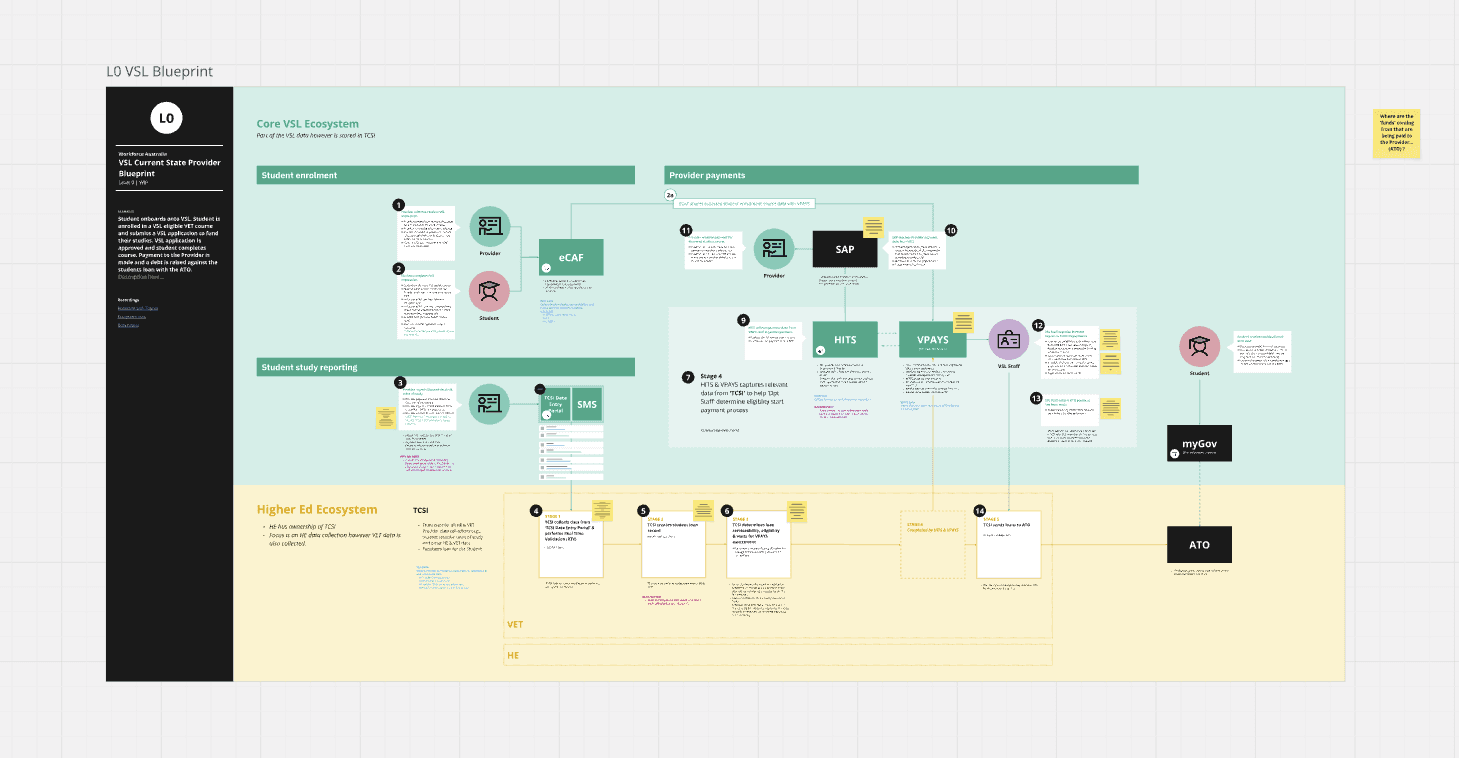
Current & future state Service Blueprints
Co-designed current state blueprints with key stakeholders.
Pain points & opportunity matrix
Developed pain point and opportunity matrix.
Worked with the Product Manager to prioritise pain points and opportunities for improvement.
Payment POC
Ran co-design sessions to build out the future payment experience.
Pre-delivery summary pack
Developed a pre-delivery summary document of the future state recommendations.
Delivery
User interviews
Conducted user interviews as needed to inform development of MVP features.
Information architecture
Card sorting
Ran moderated card sorting exercises with multiple teams to define future scope.
Tree testing
Ran remote tree testing to test proposed IA.
Analysed data and made recommendations for improvement.
Flows
Co-designed flows with key stakeholders.
Detailed flows mapped against key templates.
Co-design workshops
Ran co-design sessions, and workshops with business units to align on individual key needs and validate the future state experience.
Wireframes
Co-design sessions with business units as needed.
Flows informed key templates.
Developed key wireframe templates, liaising closely with UI designers.
Usability testing
Developed a discussion guide with key scenarios relevant to each business unit and team.
Ran recurring remote usability testing throughout project lifecycle.
Synthesised findings and developed usability reports that were shared with stakeholders and Product Owners for prioritisation.
The Impact
Increased staff efficiency across multiple business units by removing need for manual processes
Increased visibility of data, resulting in the reduction and removal of human and system error scenarios
Improved service experience that supports the business to carry out provider compliance and assurance activities
Developed an automated Provider payment platform, improving overall efficiencies.
Why it Matters
The business teams have had to build their own view of the data in order to carry out their work, which resulted in inefficiencies and human error.
Reflections & Learnings
This project provided many learnings and required ongoing adjustments before we were able to find our bearings. A few key learnings that I will bring with me to my next project:
Close collaboration between Service Design and Product Management is essential to avoid silos developing and to ensure there is a balanced view of the high-level vision with detailed analysis.
The right team structure from the outset is critical to ensure the project is set up for success. Ideally Service Design is embedded within a core cross-functional team to collaborate on analysis early within the project to ensure delivery teams have the clarity they need.
Understanding team members’ comfort with ambiguity is important; while an experience-led approach is ideal, some complex back-end processes may need resolution first to enable confident engagement in design and solutioning.